New York State Department of Environmental Conservation’s Approval of Pipeline Project
By Reyna Lee, ELR Senior Staffer, Fordham University School of Law, Class of 2026
On November 7, 2025, New York and New Jersey state officials approved a proposal for a pipeline project that the New York State Department of Environmental Conservation (NYSDEC) previously rejected due to environmental concerns. Williams Companies (Williams)–an energy company based in Tulsa, Oklahoma–proposed the pipeline. The Northeast Supply Enhancement project is an expansion of an existing natural gas pipeline system that will bring more natural gas to the New York City area from Pennsylvania. Williams designed this pipeline expansion to meet the growing demand for energy in densely populated areas such as Brooklyn, Queens, Staten Island, and Long Island, and increase the existing system’s capacity by about 400,000 dekatherms per day–enough natural gas to meet the daily needs of approximately 2.3 million homes. The offshore pipeline will run 23 miles underneath Raritan Bay and the lower New York-New Jersey Harbor. Additionally, the project includes building nearly 3.5 miles of onshore pipeline near and through New Jersey wetlands, as well as a new natural gas compressor station in northern New Jersey.
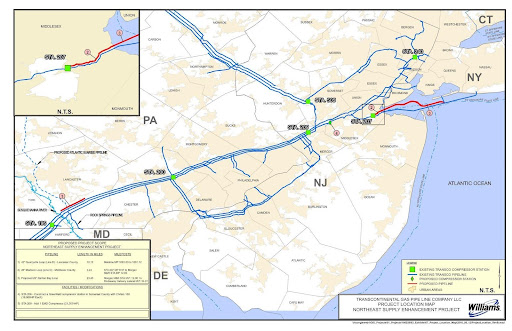
(Project Location Map; Northeast Supply Enhancement Project)
To move forward with this project, Williams secured permits pursuant to Sections 401 and 404 of the Clean Water Act (CWA) from the New Jersey Department of Environmental Protection and the NYSDEC. At the federal level, the CWA establishes structures for regulating discharges of pollutants into waters and for setting quality standards for surface waters. More specifically, under Section 401 of the CWA, a federal agency may not issue a permit or license to conduct any activity that may result in any discharge into waters of the United States unless the NYSDEC issues a Section 401 Water Quality Certification (WQC), verifying compliance with state water quality requirements. New York state water quality standards set forth the maximum allowable levels of chemical pollutants for state waters. All waters in New York are classified for their ‘best uses’ (e.g., fishing, drinking water, swimming), and the NYSDEC sets the water quality standards to protect those uses. In New York, applicants for a federal license or permit for projects that may affect water quality must apply for and obtain a WQC from the NYSDEC.
Despite NYSDEC approval, some environmental agencies are dissatisfied with New York State’s decision to permit pipeline construction. Most recently, on November 18, 2025, a coalition of environmental nonprofits sued the NYSDEC for approving the water quality certification for the pipeline project. One of the main grievances the plaintiffs expressed in the lawsuit is that the NYSDEC previously rejected the project’s permit applications more than once, so this reversal represents a 180-degree turn from the NYSDEC’s prior decisions. Representatives of the nonprofits suing the NYSDEC claim that there is nothing different about Williams’ new pipeline proposal that justifies the NYSDEC’s decision, and that if built, the pipeline would still pose a direct threat to the water quality and marine life of New York waters. Representatives are also concerned that dredging the seabed to bury the pipeline will kick up years of pollutants that have settled into the sediment, polluting the water and endangering the wildlife population. National Grid, an energy company that provides gas to about two million customers in New York City and Long Island, will manage the pipeline’s gas, meaning New Yorkers will likely foot the bill for the project’s costs. Some National Grid customers could expect a 3.5% increase to their monthly energy bill.
According to Williams’ timeline, construction for the project is scheduled to start in the third quarter of 2026. Despite the ongoing backlash from environmental nonprofits, pressures from the current administration and rising energy demands throughout New York support the realization of the NESE pipeline project.